

















![[GALLERY] Walking in (Downtown) Memphis](https://stmarystatler.org/wp-content/uploads/2024/04/E1DAD3FE-E2CE-486F-8D1D-33D687B1613F_1_105_c.jpeg)







The change is noticeable. The walk to chapel is no longer a race to claim a seat, the din of hallway conversation has become slightly less raucous and the number of teachers has shrunk.
St. Mary’s, like other schools all over the country, has been burdened by a convergence of circumstances in the past several years – both a shrinking local population and a steep birthrate decline following the 2008 recession that have contributed to the school’s population depletion.
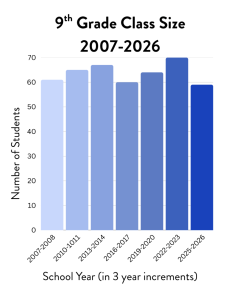
From 2017-2023, freshman classes averaged 72 students. But since students born after the recession have entered high school, St. Mary’s has welcomed their smallest freshman class since 2007, totaling just 59 freshmen.
In the years following 2008, people postponed having children due to major economic deterioration nationwide. According to research published by the Brookings Institute, the birth rate in 2007 was 69.1 births per 1,000 women, but by 2012 the rate had dropped to 63 births per 1,000 women, a 9% decrease that meant approximately 400,000 fewer births nationwide.
Nicole Hernandez, director of admission and financial aid, said you can see the results of the recession clearly in the middle school.
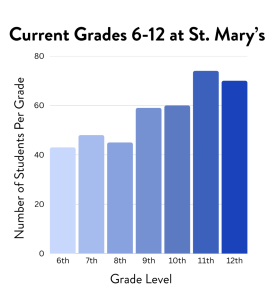
“We saw our biggest demographic shift around 2012 or [2013],” she said, pointing to the years in which birth rates fell to historic lows. “Our smallest classes right now are the fifth through eighth grades. That’s right after the recession.”
She stressed that this isn’t because families are applying and choosing other schools.
“[St. Mary’s] yield on people that apply has stayed pretty constant, but it is fewer applications,” she said.
With fewer children to teach, the size of the faculty is scaling down as well.
In the past four years, four middle school teachers have left, yet only one has been replaced. The remaining teachers have instead taken on the responsibilities of the teachers that have left.
After Andrea Zimmerman, former eighth grade civics teacher, retired following the 2024-25 school year, Ben Graunke took on the job of eighth-grade civics teacher and Model UN coordinator. Graunke accepted these jobs on top of his existing position as sixth-grade ancient history teacher.
The smaller student body is evident not only on a schoolwide scale but also in individual classrooms. Sometimes having fewer teachers has necessitated the combination of smaller class periods, thus causing some teachers to manage larger classes than before.
Other teachers have had to adapt to smaller classes and employ different teaching methods based on the number of students.
Rachel Scott, middle school math and science teacher, has noticed the change herself.
“I think if you just look at the numbers from when I started, classes have gotten smaller as years have gone on,” Scott said. “There’s pros and cons to both. Bigger classes, they get to work in different groups and with different people… Smaller classes, you get to know them better, you get more one-on-one time.”
For Dalton Lyon, AP U.S. history teacher, the shift to a smaller student body feels familiar.
“It kind of got bigger and then it seems to be going back, frankly, to the size where I started in 2011,” Lyon said. “When I got here, I think it was 50 to 55 sophomores.”
Having taught classes ranging from four to 250 students, Lyon finds this year’s average of 18 students to a section to be a well-balanced group.
“[Humanities teachers] need to spend substantial time grading essays,” he said. “I think that’s where things like class size and grade size really do matter. They have to be kind of careful about overloading certain teachers with grading, and there’s more of a happy medium.”
Lyon has found it necessary to alter his teaching style based on the relative size of his classes.
“In those smaller classes, [it’s] a lot more student-led work, less of me talking and more project-based things,” Lyon said. “I’d say in general classes of 10 to 18 are pretty ideal for discussion-based Socratic teaching.”
The shift in class sizes has repercussions beyond the classroom.
The current seniors, born in 2007 and 2008 prior to the drop in birthrates, have a significantly larger class compared to those following them. There are currently 59 freshmen and 70 seniors.
It has caused difficulty in pairing each freshman with senior, a St. Mary’s tradition. This year there are 14 instances of double-senior to single-freshman pairings.
Cleo Christian is one of the freshmen assigned two seniors, and has found that the dual experience has complicated finding connections with both.
“[My seniors] are very different people,” Christian said. “I can talk to them one at a time, but as a group it doesn’t really work out.”
But for Lillie Ireland, sharing a freshman has been preferable.
“[My freshman year], my senior introduced me to a lot of people,” Ireland said. She was relieved to share a freshman when it came to her senior year.
“Not all of the responsibility is on me,” Ireland said. “It’s been nice because we’ve each been individually hanging out with her.”
The reduction in class size has forced St. Mary’s to adapt, but Hernandez does not believe it will shrink further.
“I think once we get past these [current juniors and seniors], our enrollment will stay a little more constant,” Hernandez said.“We’re hopeful about the future, and St. Mary’s is in a good position,” said Hernandez. “Even with reduced numbers, we’ve been able to manage.”